
Managed Engineering Services vs Staff Augmentation in 2025
TL;DR
Staff augmentation adds individual engineering capacity on a per-resource basis, while an outcome-based managed development team takes ownership of a specific roadmap segment under a fixed-velocity contract. Choose staff augmentation when you need to fill strategic skill gaps in your existing team, and opt for a cross-functional pod when you require dependable delivery without disrupting your core remote engineering team’s focus.
Table of Contents
Two Models, Two Strategic Promises
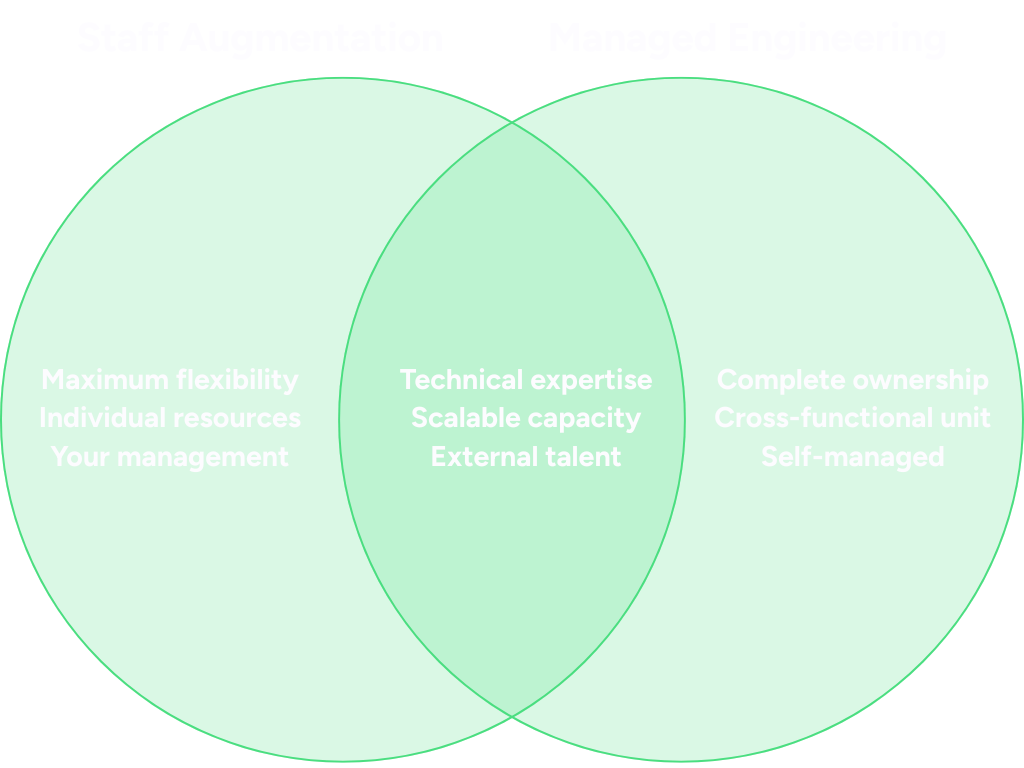
Staff Augmentation
You invest in direct hands-on-keyboard capacity by bringing in specialists (such as Kubernetes experts, React Native professionals, or Flutter developers) to complement your existing team. While you gain immediate access to specialized skills, you retain responsibility for daily stand-ups, backlog management, and project risk.
Staff augmentation shines when you have strong technical leadership but need additional capacity quickly. This approach works best for organizations with established processes who need specialized expertise for a defined period. Your internal tech leaders maintain control while gaining the flexibility to scale teams as project requirements evolve.
Perfect for: Companies with capable management looking to fill specific skill gaps without long-term commitments.
Outcome-Based Outsourcing
You entrust a clearly defined outcome to a managed development team. The vendor assembles a specialized squad, executes fixed-scope sprints under a velocity-based contract, and guarantees successful delivery. This approach transfers both implementation details and delivery risk to your partner organization.
A dedicated managed team delivers superior results when you need end-to-end ownership of a distinct product segment. Your core team stays focused on strategic priorities while the managed squad handles complete execution of the defined scope.
Perfect for: Organizations seeking predictable timelines and budgets with clear boundaries and defined success metrics.
Is your 2025 roadmap at a crossroads?
Book a complimentary 30-minute strategy consultationContract Structures & Pricing Models
Staff Augmentation: Flexibility with Oversight Responsibility
The time-and-materials framework directly ties hours to dollars, giving you maximum flexibility for evolving requirements. However, your organization bears the estimation risk and needs robust management processes to ensure productivity.
Outcome-Based: Predictability with Shared Success Incentives
Performance-linked compensation aligns payment with concrete deliverables—whether measured through sprint velocity, feature releases, or other defined KPIs. The vendor assumes estimation responsibility while you gain budget predictability and simplified financial planning.
Finding the Right Balance
Traditional fixed-price models force vendors to add significant padding to mitigate risk, while time-and-materials arrangements can reward inefficiency. Outcome-based contracts provide the ideal middle ground—you pay for measurable value delivered rather than hours consumed.
This balanced approach explains why many 2025 outsourcing models center on velocity points or feature delivery metrics. Both parties gain clear incentive alignment focused on efficient, high-quality delivery.
The Cross-Functional Pod Advantage
A dedicated cross-functional team eliminates common outsourcing challenges through focused expertise, reduced context switching, and streamlined communication. Domain knowledge stays contained within a self-sufficient unit that handles everything from requirements to deployment, while your core team avoids productivity-draining distractions.
Internal pod coordination eliminates cross-team dependencies that often delay traditional outsourcing efforts, creating a more efficient delivery pipeline that consistently meets expectations.
Quality Assessment: Outsourcing vs In-House Development
With proper implementation, outsourced teams now consistently match or exceed in-house quality standards. This parity comes from mandatory code reviews, modern AI-assisted development tools, and specialized expertise focused on discrete components. When guided by clear contractual requirements and integration with your GitHub organization, quality concerns become a non-issue.
AI-Assisted Development Benefits
The emergence of AI coding assistants like GitHub Copilot has transformed both outsourcing models by increasing senior developer productivity by approximately 30%. This enhancement accelerates sprint velocity in staff augmentation while maintaining your cost structure, creates margin capacity in managed squads while preserving your fixed price, and improves overall code quality through AI-powered suggestions and reviews.
Best Practices for Success
1. Define Clear Success Criteria
Start with precise, measurable outcomes that define both functional requirements and quality standards. Document specific acceptance criteria that leave no room for interpretation.
2. Evaluate Real Production Code
Don’t rely on portfolios alone—examine actual code contributions through live pull requests. Look for quality indicators, documentation practices, and how teams respond to feedback.
3. Start With a Pilot Engagement
Test team dynamics and communication patterns through a small, paid pilot sprint before committing to larger initiatives. This reveals real-world performance without significant risk.
4. Maintain Complete Visibility
Integrate the external team into your CI/CD pipelines and ensure access to all project artifacts. Regular, transparent reporting keeps everyone aligned with minimal overhead.
5. Protect Your Intellectual Property
Secure your assets through proper contracts that explicitly assign copyright, consider code escrow for business continuity, and document knowledge transfer processes.y assign copyright, consider code escrow for business continuity, and document knowledge transfer processes.